
Skip to content
KENPRO

KENPRO

Project Management | Research | Publishing | ICT | Training Solutions

Menu
  • HOME
  • WHO WE ARE
    • About Us
    • Our Team
  • WHAT WE DO
    • Kenpro Biogas for Schools
    • Kenpro Biogas Installation Project
    • KENPRO SOLAR PROGRAM
    • KENPRO GREEN BUILDING INITIATIVE (KGBI)
    • SMART AGRICULTURE
      • El-Paradiso Demo Farm
    • PROJECT MANAGEMENT UNIT
      • Funding Proposal Writing
      • Efunding Platform
      • Project Evaluation
      • Feasibility Studies
      • Baseline Surveys
    • RESEARCH UNIT
      • Research Proposal Writing
      • Data Coding and Analysis
    • PUBLISHING UNIT
      • ARJESS Publications
      • Academic Journals
      • Book Publishing
    • TRAINING UNIT
      • Project Management Training
      • Research Training
      • ICT Training
    • INTERNSHIP AND MENTORSHIP
  • OUR IMPACT
  • OUR PARTNERS
  • OPPORTUNITIES
    • Internship Program
    • Apply for Internship
    • Apply for training
  • ARJESS JOURNAL
  • CONTACT US
Menu

Overview of Project Planning

Posted on January 31, 2021 by kenpro kenya

Introduction
Planning is one of the most important project management and time management techniques. It is a rational determination of how to initiate, sustain, and terminate a project. In essence, failure to plan, is planning to fail. Project planning involves defining clear project goal and objectives, outlining project output, generating project activities and allocating resources appropriately to inform successful project implementation process. It is at this phase of planning that human, material and financial resources are organized in a better way to undertake given activities within constraints of time and cost so as to achieve some intended project objectives. Figure 2 shows project planning flowchart.

Figure 2: Project planning flowchart

Project Planning Parameters Explained
Goal
This is the general objective of the project. The goal specifies the benefits, which the beneficiaries will enjoy as a result of the project.

Objectives

  • A project objective is the situation that is expected to be present at the end of the project.
  • Objectives SHOULD be SMART (Specific, Measurable, Achievable, Realistic and Time-bound) in order to contribute to achieving the longer-term aims. Objectives form the basis for the activities of a project and also serve as the basis for project evaluation (Gosling, 2000).

For an objective to be good, it should be SMART, meaning it should be:

  • Specific (what is expected to change and in what way, where and for whom).
  • Measurable or monitorable (not necessarily using figures, but so that you can demonstrate that change has taken place).
  • Achievable (agreed between stakeholders, although different stakeholders may agree to have different objectives).
  • Relevant (to all stakeholders and the real problems and local realities) or Realistic (given real problems, available resources and local realities).
  • Time-bound (should indicate the time frame). Objectives may need to be changed as a result of changing circumstances or a change in understanding of the situation.

Outputs
These are tangible, measurable results expected to be realized after successful completion of a project. All project activities are performed under certain requirements in order to develop a desired measurable output (Task Management Guide, 2020).

Activities

These are all the steps, which the project takes to provide the various services and products.

  • Project activities are derived from the project objectives
  • Project activities provide a platform for drawing up the project budget.

Activities are presented using activity schedule. The activity schedule enables us to consider when our activities will happen and for how long and who is responsible. The activity schedule helps us to look at the sequencing of activities because some activities will depend on others being completed first.

Use the activity schedule during the project to monitor progress. Ask questions like:

  • Why are these activities not happening to schedule?
  • What will be the effect of this on other project activities?
  • How can we catch up?

The activity schedule helps us to look at the sequencing of activities because some activities will depend on others being completed first.

Activities are presented using activity schedule. The activity schedule enables us to consider when our activities will happen and for how long and who is responsible. The activity schedule helps us to look at the sequencing of activities because some activities will depend on others being completed first. Table 1 shows activity schedule.
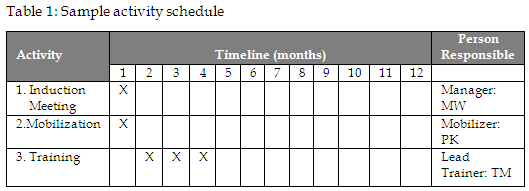
In project management, planning is undertaken to ensure that the activities performed in project implementation (execution) phase are properly scheduled (with timeline), executed and controlled (by the responsible).

Inputs

These are physical and non-physical inputs that facilitate implementation of a project. They include human, material and financial resources. Virtual aspects such as opportunity, demand and access, and time are also considered as inputs.

Conclusion

Project planning phase is the heart of the project life cycle. It helps in setting a set of plans meant to guide project team through the process of implementation. Poor project planning in terms of designing objectives, scheduling activities and allocating resources (human, material and financial) to realize the projects’ objectives can hinder effective project implementation. Thus, a close attention should be given to project planning.

Bibliography

Barron, M., & Barron, A. (2014). Project Management. Texas: Midas Green Innovations

Gosling, D. (2001). Educational development units in the UK-what are they doing five years on?. International Journal for Academic Development, 6(1), 74-90.

Task Management Guide (2020). What is Project Output? Available online at http://www.taskmanagementguide.com/glossary/what-is-project-output-.php

Suggested Citation

Wanjohi, A.M. (2020). Project Planning and Management Handbook. Nairobi: KENPRO Publications


Leave a Reply Cancel reply

Your email address will not be published. Required fields are marked *

Categories

  • Academic Papers (53)
  • Agriculture (10)
  • Announcements (7)
  • ARJESS Publications (1)
  • Business Articles (15)
  • Education Articles (6)
  • El-Paradiso Demo Farm (3)
  • Environment Articles (13)
  • Funding Agencies (5)
  • Funding Proposal Services (4)
  • Health Articles (1)
  • Journals Index (7)
  • Kenpro Biogas Program (21)
  • Kenpro Green Building Initiative (1)
  • Kenpro Solar Program (5)
  • NGOs Network (4)
  • Project Management Articles (34)
  • Project Management Guide (3)
  • Publications (8)
  • Publishing Projects (1)
  • Renewable Energy (10)
  • Research Abstracts (5)
  • Research Proposal Guide (36)
  • Statistics Articles (5)
  • Technology Articles (4)
  • Training Program (2)
  • Uncategorized (2)

Recent Posts

  • Importance and Ethics of Project Management Consultancy Services
  • Funding Agencies Financing Renewable Energy
  • Financing Renewable Energy Technologies
  • Components of Stakeholder Engagement
  • The Impact of Teamwork on Project Success

Site Menu

  • HOME
  • WHO WE ARE
    • About Us
    • Our Team
  • WHAT WE DO
    • Kenpro Biogas for Schools
    • Kenpro Biogas Installation Project
    • KENPRO SOLAR PROGRAM
    • KENPRO GREEN BUILDING INITIATIVE (KGBI)
    • SMART AGRICULTURE
      • El-Paradiso Demo Farm
    • PROJECT MANAGEMENT UNIT
      • Funding Proposal Writing
      • Efunding Platform
      • Project Evaluation
      • Feasibility Studies
      • Baseline Surveys
    • RESEARCH UNIT
      • Research Proposal Writing
      • Data Coding and Analysis
    • PUBLISHING UNIT
      • ARJESS Publications
      • Academic Journals
      • Book Publishing
    • TRAINING UNIT
      • Project Management Training
      • Research Training
      • ICT Training
    • INTERNSHIP AND MENTORSHIP
  • OUR IMPACT
  • OUR PARTNERS
  • OPPORTUNITIES
    • Internship Program
    • Apply for Internship
    • Apply for training
  • ARJESS JOURNAL
  • CONTACT US

Categories

  • Academic Papers (53)
  • Agriculture (10)
  • Announcements (7)
  • ARJESS Publications (1)
  • Business Articles (15)
  • Education Articles (6)
  • El-Paradiso Demo Farm (3)
  • Environment Articles (13)
  • Funding Agencies (5)
  • Funding Proposal Services (4)
  • Health Articles (1)
  • Journals Index (7)
  • Kenpro Biogas Program (21)
  • Kenpro Green Building Initiative (1)
  • Kenpro Solar Program (5)
  • NGOs Network (4)
  • Project Management Articles (34)
  • Project Management Guide (3)
  • Publications (8)
  • Publishing Projects (1)
  • Renewable Energy (10)
  • Research Abstracts (5)
  • Research Proposal Guide (36)
  • Statistics Articles (5)
  • Technology Articles (4)
  • Training Program (2)
  • Uncategorized (2)

Latest Posts

  • Importance and Ethics of Project Management Consultancy Services
  • Funding Agencies Financing Renewable Energy
  • Financing Renewable Energy Technologies
  • Components of Stakeholder Engagement
  • The Impact of Teamwork on Project Success
  • Renewable Energy Technology Investment Models
  • Renewable Energy Applications in Agro-Processing and Post-Harvest Management
  • Role of Renewable Energy in Agriculture in Kenya
  • Cost–Benefit Analysis of the Use of Renewable Energy in Agriculture
  • Sustainability As a Key Component of Project Planning and Management
  • Challenges and Interventions of Stakeholder Engagement in Project Management
  • Role of Leadership in Ensuring Project Success
  • THE EFFECT OF MONITORING AND EVALUATION ON PROJECT SUSTAINABILITY
  • TECHNOLOGY ADOPTION IN CONSTRUCTION INDUSTRY
  • STRENGTHENING PROJECT OUTCOMES THROUGH INTENTIONAL RISK MANAGEMENT
  • Risk Response Strategies in Project Implementation
  • Impact of Effective Communication on Project Management
  • Key Success Factors in Project Planning
  • INEFFECTIVE MONITORING AND EVALUTAION SYSTEMS AS A CAUSE OF PROJECT FAILURE
  • Fish Faecal Waste as a Feedstock for Biogas Production
  • Why it Matters: Women and the Clean Energy Transition in Africa
  • KENPRO SDGs-Based Renewable Energy Impact
  • Top Risk Factors in Moving Projects and How to Reduce Them
  • An Overview of Green Building Concept for Sustainable Housing
  • Step by Step Sample Size Determination for a Known Population Size
  • Paradox in Kenya’s Education System: Transitioning from 8-4-4 Education System to CBC to CBE
  • Team Morale Tips During Workplace Transitions
  • Water Quality Management and Sustainable Fish Farming in Arid and Semi-Arid Areas: Challenges, Opportunities, and Climate-Resilient Strategies
  • A Practical Guide to Soil Testing
  • The Hidden Costs of Poor Communication in Project Teams
  • Explaining the Theory of Change in the Context of Development Projects
  • Monitoring and Evaluation Training
©2026 KENPRO | This website is maintained by KENPRO ICT Team. For inquiries about our services, kindly contact us | E: kenprokenya@gmail.com | M: +254 725 788 400
All published content on this site reflects the views of the authors and not necessarily those of KENPRO.
The organization assumes no responsibility for errors or omissions in the content.

Powered by
►
Necessary cookies enable essential site features like secure log-ins and consent preference adjustments. They do not store personal data.
None
►
Functional cookies support features like content sharing on social media, collecting feedback, and enabling third-party tools.
None
►
Analytical cookies track visitor interactions, providing insights on metrics like visitor count, bounce rate, and traffic sources.
None
►
Advertisement cookies deliver personalized ads based on your previous visits and analyze the effectiveness of ad campaigns.
None
►
Unclassified cookies are cookies that we are in the process of classifying, together with the providers of individual cookies.
None
Powered by